
If you don’t like the weather in Middle Tennessee, just wait five minutes. In Maury County, we frequently experience the “Four Seasons in a Week” phenomenon—where Monday is a 65°F spring afternoon and Thursday morning sees a 14°F arctic blast coming off the Duck River.
This rapid temperature swing is exactly why dripping your faucets is a vital defense for a Tennessee homeowner.
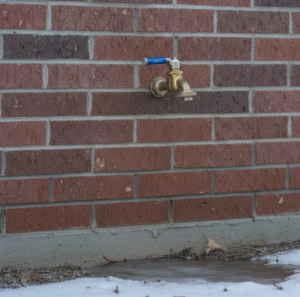
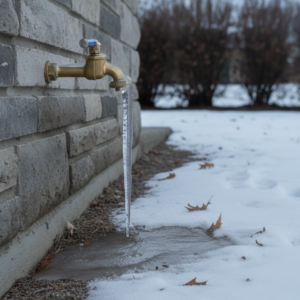
When the weather stays cold, pipes reach a thermal equilibrium. But in Columbia, our “flash freezes” catch pipes off guard. A pipe that was sitting in 60°F soil on Monday hasn’t “tempered” by the time the sub-zero wind chill hits on Thursday.
The Real Reason: When water freezes, it expands. If a pipe is closed at both ends, that expansion creates immense pressure between the ice blockage and the faucet. The drip acts as a pressure relief valve. Even if the pipe freezes, the pressure has an escape route, preventing the pipe from “popping.”
Leaving a garden hose attached can lead to burst pipes during harsh Maury county weather.
In Columbia, we often see a mix of historic homes with brick exteriors and modern developments with vinyl siding. This variety in architecture means a “one-size-fits-all” approach to faucet protection usually fails.
While hard foam covers are the traditional choice, the Insulated Sock has become the gold standard for Middle Tennessee homeowners due to its versatility and superior seal against the wind.
A hard foam cover relies on a single rubber loop to stay centered. If the wind catches it, or if your siding is uneven, it leaves a gap.
The Insulated Sock functions like a high-tech mitten for your spigot. It uses a drawstring or Velcro strap to cinch the insulation directly against the house, eliminating the “chimney effect” where cold air leaks in from the bottom.
Feature | Hard Foam Covers | Insulated “Socks” (Fabric) |
Best For | Perfectly flat, flush-mounted spigots on smooth siding. | Irregular shapes, protruding spigots, or stone/brick exteriors. |
Thermal Protection | Creates a “dead-air” pocket of warmth. | Uses multi-layer insulation (like a winter coat) to trap heat. |
Durability | Plastic can become brittle and crack in the sun after years of use. | Heavy-duty Oxford cloth is tear-resistant and flexible. |