Living in Columbia, Tennessee, means enjoying the scenic beauty of the Duck River, but it also means dealing with the specific challenges of our local infrastructure. For homeowners from the historic homes downtown Columbia to the new developments near Neapolis, the water heater is often the most overworked appliance in the house.
Between 2024 and 2026, energy efficiency standards and local water quality shifts have changed the “rules” for water heater maintenance. If your system is over eight years old, you aren’t just losing money on monthly bills—you’re likely fighting a losing battle against limestone and sediment.
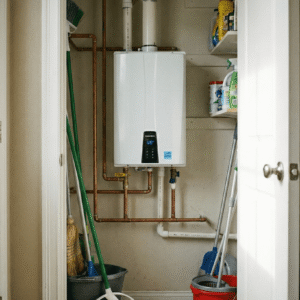
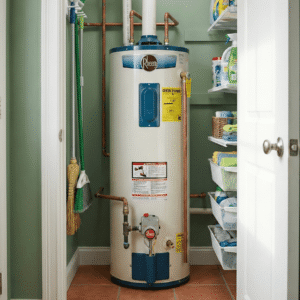
Many plumbing articles tell you that a water heater lasts eight to twelve years. Here in Columbia, we face a few extra challenges!
The Limestone Factor: Columbia’s water is notorious for high mineral content. This “hard water” creates a layer of calcium at the bottom of tanks, acting as an insulator between the flame and the water. You end up paying to heat a rock before you heat your water. Go to your shower right now and wipe a washcloth over the shower head. You’ll likely knock some sediment off and get a tiny boost in water pressure!
Pressure Fluctuations: Speaking of water pressure, recent growth (so many new homes!) in Maury County has led to fluctuating water pressure in certain neighborhoods. Without a properly calibrated Thermal Expansion Tank, these spikes can cause premature tank failure.
To truly master your home’s plumbing health in 2026, you need to look beyond the “lit pilot light.” Columbia’s unique geography—specifically the limestone-rich Highland Rim—means our water behaves differently than it does in other parts of the country.
Understanding these four concepts will help you prevent emergencies and maximize your system’s lifespan.
Think of the anode rod as a lightning rod for corrosion. Inside your steel tank, a magnesium or aluminum rod hangs in the water. Because these metals are more “active” than steel, the corrosive elements in Columbia’s water attack the rod instead of the tank lining. If you have a water softener (common in Maury County), your anode rod will actually dissolve up to 3x faster because softened water is highly conductive.
PB Pro Tip: We recommend checking your rod every 2–3 years. If it looks like a chewed-up piece of wire, it’s done its job and needs replacement before the water starts eating your tank. Let us know if your odor has an odor! We have a special anode rod for you.
Gone are the days of the “Energy Factor” (EF). As of late 2025, all new units use the Uniform Energy Factor (UEF). This is a highly accurate measure of how much heat is lost while the water just sits in the tank.
The FHR tells you exactly how many gallons of hot water a fully heated unit can deliver in one hour of heavy use.
When it comes time to sell your home or pass a 2026 inspection, “good enough” plumbing won’t cut it. Local codes in Columbia have specific requirements that many DIYers miss:
| Feature | Traditional Tank | Tankless (On-Demand) | Hybrid Heat Pump |
| Upfront Cost | Lowest | High | Moderate-High |
| Space Required | 10–15 sq. ft. | Minimal (Wall-mount) | 10–15 sq. ft. |
| Lifespan | 8–10 Years | 20+ Years | 13–15 Years |
| Best For… | Budget-conscious flips | Large or growing families | Max energy savings |
Myth: “If my water heater isn’t leaking, it’s working fine.”
Reality: A water heater can “work” while being 40% less efficient than it was at installation. If you hear a popping or “kettling” noise, that’s the sound of steam bubbles escaping through a layer of sediment. You’re burning money every time you turn on the tap.
We aren’t just technicians; we’re your neighbors. We understand that a broken water heater isn’t just an inconvenience—it’s a disruption to your life.
Ready to upgrade your home’s efficiency? Contact PB Plumbing today for a professional water heater evaluation! Just call 931-377-2840