
A burst pipe is a race against the clock. Within minutes, a single rupture can release dozens of gallons of water, potentially leading to structural and permanent property damage.
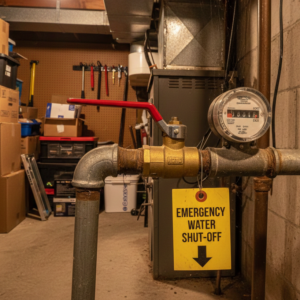
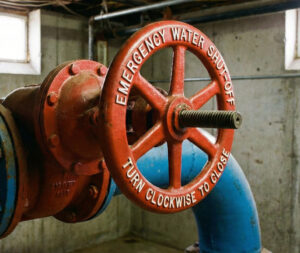
The moment you hear rushing water or see a ceiling bulge, you must locate and turn off your main water shut-off valve.
Claim: You should always cut the power during a flood.
Reality: Only cut the power if water is nearing outlets, appliances, or light fixtures. Never enter a flooded room to reach a breaker box if you have to stand in water. If the panel is in a dry area, shut off the breakers for the affected zones immediately.
To satisfy insurance adjusters, documentation must be your second priority after safety. Ask your insurance agent what documentation is needed to process your claim.
Many standard policies cover “sudden and accidental” water damage. Check your policy or ask your insurance agent to determine your coverage.
| Repair Method | Best For | Complexity | Longevity |
| SharkBite / Push-Fit | DIY Emergency Fix | Low | Temporary/Medium |
| Pipe Repair Clamp | Pinholes/Small Splits | Low | Emergency Only |
| Soldered Copper | Permanent Repair | High | Decades |
| PEX Crimp | Modern Flexible Lines | Medium | Permanent |
A common myth is that ice expansion itself “cracks” the pipe. In reality, as ice forms, it creates a “plug.” The ice then grows toward the faucet, trapping a column of water between the plug and the closed valve. The resulting hydrostatic pressure—not the ice—is what causes the pipe to fail at its weakest point.
Expert Tip: In 2026, many homeowners are moving toward Smart Water Leak Detectors. These IoT devices (like Moen Flo or Phyn) monitor flow rates and can automatically shut off your water main if they detect a burst, even if you’re not home.
Need emergency plumbing assistance? Contact PB Plumbing now. Available 24/7 on demand. Just call 931-377-2840